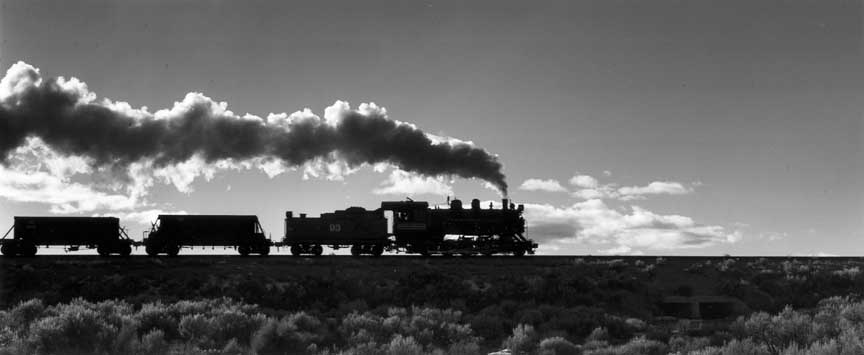
While watching The Lord of the Rings trilogy and The Hobbit, I couldn't help but feel bad for the orcs.
When a human or dwarf dies, everyone's so sad and we need separate scenes for their deaths and their mourning. When an orc dies? NOTHING! NO ONE CARES!! :'(
Orcs are social living beings as well. They live their everyday lives just like us, they have families and friends and children.
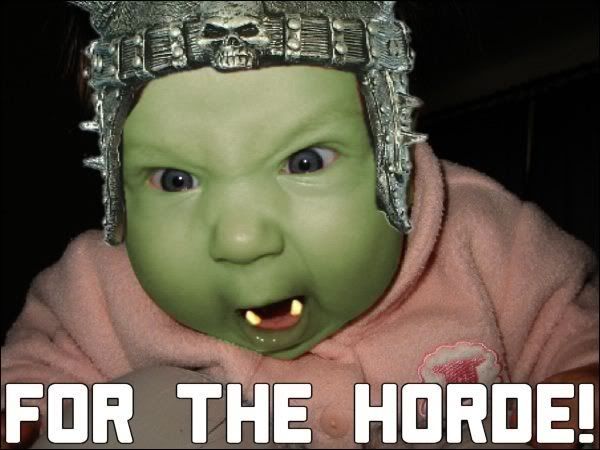
Orcs are depicted as such ugly and nasty creature, that not even the orcs care that orcs die! It's like orcs are such terrible creatures that they should be slaughtered for everyone's sake, even the orcs sake.
Next time you watch LOTR or Hobbit, please feel some compassion for the orcs as well. And goblins and trolls and wargs.
The reason we don't care about the orcs is that they're really depicted as ugly creatures, and the Halo effect(holdudvar hatás) takes control over our feelings.
The Halo Effect is when you attribute properties to a person because of your general impression* of them - basically because of their looks. For example orcs look ugly, they are probably evil creatures.
It also works the other way - ladybugs are very nice and cute insects and you enjoy having them walk around on your skin. If they wouldn't have dots on them and they would be all black, and maybe have a different shape you would freak out because of them.
When I was young, I hated the show: "Courage the cowardly dog", because it was full of scary and disgusting things, and Courage, the main character, wasn't appealing at all. Years later I realized that maybe that was the point - ugly messed up creates can have good souls and amazing personalities.
Unfortunately, our beloved Disney is probably the strongest enforcer of the halo effect. Evil characters are ugly and good characters are beautiful (in the Beauty and the Beast this isn't as true as in the other movies - but seriously the point of that movie is that if you're rich than you're also OK)
So that's that - please think about the poor orcs next time you watch a movie with them. And maybe try to image the movie with switched roles!
*it works the other way around as well - if you chat online with someone for a long time and you've never seen them and they are a good chat-partner then you imagine a very pleasant person on the other side; if they are annoying then you don't imagine them as prince charming
Thursday, August 29, 2013
Sunday, August 25, 2013
Thursday, August 15, 2013
Wild Railroad Carriage
So I searched Wikipedia for the correct phrase, and it turns out that the things that make up a train are called railroad cars, or railcars for short (US and Canada), but in the UK it's railroad carriage... which is the expression I'll be using, because it sounds nicer.
Philippa Foot (1920-2010) proposed the following situation:
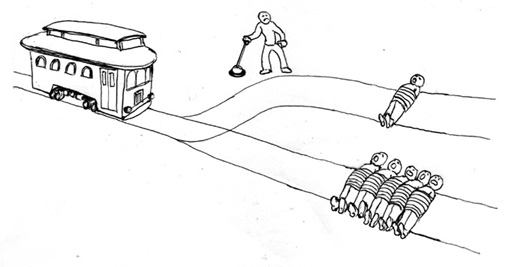
There's a wild railroad carriage going down a hill, seemingly unstoppable, and there are 5 people tied to the tracks... and you are there watching.
Luckily you notice a railroad switch, which can change the path of the carriage to another track, where there's only one person strapped to the track.
What do you do?
You switch the tracks; that's what most people would do.
So along comes Judith Jarvis Thompson (1929-), who puts a twist in the scene:
You have the train carriage coming at full speed, 5 people tied to the tracks... but there's no switch, only some people who are passing by who haven't noticed the carriage.
You grab a person and toss him in front of the carriage before it slices up the 5 innocent people into 15 pieces; the carriage gets derailed and the 5 people are saved, but the fellow you tossed in died.
Was that correct? If so, would making this decision be harder or simpler than the last one, when all you had to do was change the switch? In fact, was changing the switch the right decision at all?
I think it's a tough thought, hope you'll be at it and think about it some more, make new scenarios; it's easy to start wandering off to other ideas from this one.
By the way this is from a book called 30 Seconds Philosophy, which is pretty good at first sight, I've only read a part of the ideas in it, but it seems to be good and it summaries the ideas well.
Philippa Foot (1920-2010) proposed the following situation:
There's a wild railroad carriage going down a hill, seemingly unstoppable, and there are 5 people tied to the tracks... and you are there watching.
Luckily you notice a railroad switch, which can change the path of the carriage to another track, where there's only one person strapped to the track.
What do you do?
You switch the tracks; that's what most people would do.
So along comes Judith Jarvis Thompson (1929-), who puts a twist in the scene:
You have the train carriage coming at full speed, 5 people tied to the tracks... but there's no switch, only some people who are passing by who haven't noticed the carriage.
You grab a person and toss him in front of the carriage before it slices up the 5 innocent people into 15 pieces; the carriage gets derailed and the 5 people are saved, but the fellow you tossed in died.
Was that correct? If so, would making this decision be harder or simpler than the last one, when all you had to do was change the switch? In fact, was changing the switch the right decision at all?
I think it's a tough thought, hope you'll be at it and think about it some more, make new scenarios; it's easy to start wandering off to other ideas from this one.
By the way this is from a book called 30 Seconds Philosophy, which is pretty good at first sight, I've only read a part of the ideas in it, but it seems to be good and it summaries the ideas well.
These weeks
Hey! I won't be writing too much until 08.26., because I'm on vacation, but I'll try if I get the chance.
Tuesday, August 13, 2013
A Carnivorous Flower
“The sky, at sunset, looked like a carnivorous flower.”
Roberto Bolaño, 2666
Most all of us have seen a few wonderful sunsets each summer (e.g. at Lake Balaton ^^ ). In fact, most of us have also probably read about why the sky is blue - we have so much in common!
Quick summary on the sky's color: Light coming from the sun scatters off the molecules and atoms in the air in a way that lower frequencies of light (like red, orange, yellow) scatter less and higher frequencies of light (like blue, violet) scatter much more.
When the sun goes down, it seems to paint the bottom part of the sky red and orange. How?
No one knows...
Just joking - hehehe. We do know - it's the same effect that makes the sky blue!
When the sun goes down, the light coming from it has to travel through much more air.
![]() |
So when the sun is low, we have lots of light coming through the "long path" (see illustration). Because it's going through a long path, the effect of bluish light scattering away and reddish light remaining is stronger... simply because it happens through a longer path!
Cool right?
So the bottom of the sky is beautiful red and we have a nice gradient all the way to blue.
This brings us to an artistic question to think about:
-If the atmosphere were thicker, would the sky be red?
Sunday, August 11, 2013
Saturday, August 10, 2013
Follow-up on Lawn Mowing
Since I stumbled into this video about an hour ago and I got quite a bit of feedback on the Lawn-Mowing post I decided to follow up right away.
The result of capitalism's
exponential pushing up and pulling down of people
Tadaaa:
Ok the situation seems bad and unfair - it is in many ways.
Although the exponential curve draws out beautifully, at least if we cut off the top 10% we get a distribution similar to the ideal - so if we cut off the people that are in the clouds and those with whom we don't have an interaction with, it's not that bad (yeah.. it's still pretty bad).
A must see: good visualization on how fast rich people make money:
http://money.cnn.com/interactive/economy/sixty-seconds-of-salary/
Friday, August 9, 2013
The Lawn Mowing Dilema
Let's say at home we have to mow the lawn every two weeks. Luckily I'm not alone, I have a brother with whom we do it together - so we split the work.
Week 1 - I mow the lawn.
Week 2 - He mows the lawn.
Week 3 - I mow the lawn.
...
Sounds fair and simple, right?
Maybe it isn't.
Let's say on week 4, he doesn't have time to mow the lawn, so he says: I'll give you 4000 psp (imaginary money) to mow the lawn. I'm glad, because it takes me about 2 hours to mow the lawn, and that means 2000 psp/hour - that's about how much my time is valued at anyway. Cool
A few weeks later I don't have time to mow the lawn when it's my turn, so I tell my brother I'll give him 4000 psp if he does the work instead of me. Now, he's actually not happy with the offer, because he says his time is worth more - he'll do it for 5000 psp!
New system:
Week 1 - He gives me 4000 psp.
Week 2 - I give him 5000 psp.
...
I'm losing 1000 psp every two weeks, even though we're both doing the same amount of work as before. :(
What did money do when it got into the picture? Two things:
1) Money changed the picture to represent the real value of our times simply be being an intermediary trade currency.
2) Money pushed the little guy down and pulled the big guy up!
In effect I should be doing more lawn-mowing than my brother so that I won't become bankrupt.
So it seems it's important to make my time more valuable. "Everything is worth as much as its customer will pay for it". In other words my time is only worth a lot if I can actually find work for that much.
How do I make my time more valuable? Experience and education. This is a fundamental importance of education - making your time more valuable. The more valuable your time is the less you have to do and the more time you will have, simply because your time has a better price-tag.
Of course this is one of the great properties of capitalism and also one of the great problems of it. - The better you are, the easier it is for you to get even better. In this case the more my time is worth, the more time I have to develop myself to make my time be worth even more.
Sounds evil, doesn't it? Rich people with lots of free time are propelled towards becoming even richer with even more free time. In fact the capitalist pit of evil is so terrible that we have another effect stacked onto the time-value problem - the more capital (money) you have, the more you can invest and you will get even more money!
The bright side: it's worth investing! That's the (open) secret of capitalism - to invest is to prosper. Because if your time gets a little more valuable you will have more resources to invest more to get even more valuable! This is really a key momentum of the 'great American success stories' where people from poor backgrounds get to the top of the world.
In fact this is why the whole capitalism is a boomer - every second is part of a race for everyone to get more potential - everyone's racing, and whoever stays behind gets left behind - so keep investing in yourself!
Ok there's a bunch of things we could talk about here. I think probably the most important thing from this line of thought is that as long as we live in a capitalistic world, education is the single most important thing in society.
Education gives way for people to invest in themselves - it opens the gates of social mobility because people from lower layers of society can quickly break out if they have the opportunity to invest in themselves.
About investing - I should get one of these (I think it's called a mowercycle):
Week 1 - I mow the lawn.
Week 2 - He mows the lawn.
Week 3 - I mow the lawn.
...
Sounds fair and simple, right?
Maybe it isn't.
Let's say on week 4, he doesn't have time to mow the lawn, so he says: I'll give you 4000 psp (imaginary money) to mow the lawn. I'm glad, because it takes me about 2 hours to mow the lawn, and that means 2000 psp/hour - that's about how much my time is valued at anyway. Cool
A few weeks later I don't have time to mow the lawn when it's my turn, so I tell my brother I'll give him 4000 psp if he does the work instead of me. Now, he's actually not happy with the offer, because he says his time is worth more - he'll do it for 5000 psp!
New system:
Week 1 - He gives me 4000 psp.
Week 2 - I give him 5000 psp.
...
I'm losing 1000 psp every two weeks, even though we're both doing the same amount of work as before. :(
What did money do when it got into the picture? Two things:
1) Money changed the picture to represent the real value of our times simply be being an intermediary trade currency.
2) Money pushed the little guy down and pulled the big guy up!
In effect I should be doing more lawn-mowing than my brother so that I won't become bankrupt.
So it seems it's important to make my time more valuable. "Everything is worth as much as its customer will pay for it". In other words my time is only worth a lot if I can actually find work for that much.
How do I make my time more valuable? Experience and education. This is a fundamental importance of education - making your time more valuable. The more valuable your time is the less you have to do and the more time you will have, simply because your time has a better price-tag.
Of course this is one of the great properties of capitalism and also one of the great problems of it. - The better you are, the easier it is for you to get even better. In this case the more my time is worth, the more time I have to develop myself to make my time be worth even more.
Sounds evil, doesn't it? Rich people with lots of free time are propelled towards becoming even richer with even more free time. In fact the capitalist pit of evil is so terrible that we have another effect stacked onto the time-value problem - the more capital (money) you have, the more you can invest and you will get even more money!
The bright side: it's worth investing! That's the (open) secret of capitalism - to invest is to prosper. Because if your time gets a little more valuable you will have more resources to invest more to get even more valuable! This is really a key momentum of the 'great American success stories' where people from poor backgrounds get to the top of the world.
In fact this is why the whole capitalism is a boomer - every second is part of a race for everyone to get more potential - everyone's racing, and whoever stays behind gets left behind - so keep investing in yourself!
Ok there's a bunch of things we could talk about here. I think probably the most important thing from this line of thought is that as long as we live in a capitalistic world, education is the single most important thing in society.
Education gives way for people to invest in themselves - it opens the gates of social mobility because people from lower layers of society can quickly break out if they have the opportunity to invest in themselves.
About investing - I should get one of these (I think it's called a mowercycle):
Wednesday, August 7, 2013
Video of the week... or something like that!
Great video - I love the style of drawing and talking. Has no relevance to previous posts whatsoever of course :)
So the content is interesting too, but I think the drawings are why I love this piece!
Tuesday, August 6, 2013
International Communication - just a cool video
Forget learning languages.
In fact, you might as well forget those languages you know already.
Except for English... don't forget English, because you won't be able to read my blog.
Ok so why am I telling you that languages aren't important? Well they are important for the time being, but in a few years things might change. I'm going to link a video to show you how.
The video (below) is a presentation from Microsoft on translation technology. It is linked form 6:15; before that he's just talking about how cool the speech recognition software is and how great Bing Translator is (I've never used it and I don't think any of you have either).
You should definitely watch the video until 7:33. Up to that point you can see that the speech recognition system is pretty good, only a few errors slip in. Maybe in the Chinese text those errors look really stupid, but you know.. they probably get the message.
What happens at 7:33 is really cool. Check it out:
http://youtu.be/Nu-nlQqFCKg?t=6m15s
In case your YouTube isn't working, I'll tell you what happened: The guy was talking in English and we could hear his voice saying the same thing in Chinese.
I think there are a few really cool things about this:
1) We get an almost instant translation.
2) We hear it in his voice.
Number 1 isn't really a huge breakthrough... in fact number 2 isn't such tremendous breakthrough either. But just experiencing the whole thing - a guy talking in his mother tongue and a chosen language at the same time - it's cool.
And it gives way to great future technologies and opportunities. While talking to a foreigner, forget reading the translation on some kind of cool Google Glasses - you're going to hear it from your little earpiece - in his/her voice!
I think that's really great because you can speak to a group of foreigners and hear a translation and know who said what, because each translation is in a different voice.
Plus I think it's a great step towards making communication better - which I think is essential to human development.
In fact, you might as well forget those languages you know already.
Except for English... don't forget English, because you won't be able to read my blog.
Ok so why am I telling you that languages aren't important? Well they are important for the time being, but in a few years things might change. I'm going to link a video to show you how.
The video (below) is a presentation from Microsoft on translation technology. It is linked form 6:15; before that he's just talking about how cool the speech recognition software is and how great Bing Translator is (I've never used it and I don't think any of you have either).
You should definitely watch the video until 7:33. Up to that point you can see that the speech recognition system is pretty good, only a few errors slip in. Maybe in the Chinese text those errors look really stupid, but you know.. they probably get the message.
What happens at 7:33 is really cool. Check it out:
http://youtu.be/Nu-nlQqFCKg?t=6m15s
In case your YouTube isn't working, I'll tell you what happened: The guy was talking in English and we could hear his voice saying the same thing in Chinese.
I think there are a few really cool things about this:
1) We get an almost instant translation.
2) We hear it in his voice.
Number 1 isn't really a huge breakthrough... in fact number 2 isn't such tremendous breakthrough either. But just experiencing the whole thing - a guy talking in his mother tongue and a chosen language at the same time - it's cool.
And it gives way to great future technologies and opportunities. While talking to a foreigner, forget reading the translation on some kind of cool Google Glasses - you're going to hear it from your little earpiece - in his/her voice!
I think that's really great because you can speak to a group of foreigners and hear a translation and know who said what, because each translation is in a different voice.
Plus I think it's a great step towards making communication better - which I think is essential to human development.
Friday, August 2, 2013
Why is the sky blue?
As an Exploding start for my blog, the question that has bothered many of us since our childhoods: why is the sky blue?
[Really lazy people can skip the basics and jump ahead to after the second picture! They will still get the general idea I think.]
[Long post, but worth it! :) ]
Basics: Visible light - everything you see - is actually an electromagnetic wave (EMW). One way to imagine light is constantly vibrating electric and magnetic fields, just like waves.
So as a wave, it has a few important properties, like wavelength (the vibration of the wave in space) and frequency (the vibration of the wave in time). [*Anyone a bit more into physics can see that these two are basically the same if we consider space-time;] These two are interconnected by a constant (the wave speed = the speed of light), so if we know for example the frequency then we immediately know the wavelength. If the wavelength is small then the frequency will be large and vice verse. This can be expressed in a simple formula:
As you can see, visible light is only a small part of the ElectroMagnetic Spectrum. The different colors of visible light are also different frequencies of light - blue has a higher frequency and red has a lower frequency.
Why is all this important, when all we want to talk about is the sky?
The key: When light falls through a medium it scatters, and different frequencies scatter in different amounts.
The medium in our case is air. What is scattering? Imagine someone shining a green laser pointer through the air - you don't see the beam, only the beginning and the end of it. Now imagine someone pointing a laser through smoke - now you see the whole beam: this is exactly the scattering of light. Light from the laser would originally travel straight through the air and none would get to you eyes, but because of the smoke some of it scatters and you see some green from where it passes through.
Air? Exactly the same! But the scattering is much weaker than with the smoke and laser story. The light source is the sun (mostly a homogeneous mix of all the frequencies of light (=white light)).
How does light scatter? Higher frequencies scatter more than lower frequencies. How much more? Much more! For the geeks: the amount of scattering is proportional to the fourth power of the frequency!!
This means low frequencies barely scatter and high frequencies scatter a lot!! So when a beam of sunshine comes through the atmosphere, the bluer, higher frequency parts tend to go off into other directions and the lower frequency reds go straight through, which means:
Topics in the follow-up post: how to get a sunburn while freezing to death; why baby fish are asking their parents the same questions as we are and what to talk about with your girlfriend/boyfriend at a romantic sunset.
[Really lazy people can skip the basics and jump ahead to after the second picture! They will still get the general idea I think.]
[Long post, but worth it! :) ]
Basics: Visible light - everything you see - is actually an electromagnetic wave (EMW). One way to imagine light is constantly vibrating electric and magnetic fields, just like waves.
So as a wave, it has a few important properties, like wavelength (the vibration of the wave in space) and frequency (the vibration of the wave in time). [*Anyone a bit more into physics can see that these two are basically the same if we consider space-time;] These two are interconnected by a constant (the wave speed = the speed of light), so if we know for example the frequency then we immediately know the wavelength. If the wavelength is small then the frequency will be large and vice verse. This can be expressed in a simple formula:
speed (which is constant)=wavelength X frequency
For the rest of the post I will be talking only about the frequency and not the wavelength.
Summary on the basics: Light is an electromagnetic wave; important property: frequency.
Ok, what changes when we change the frequency of light? Everything! What will be important for us: the color. Check it out:
As you can see, visible light is only a small part of the ElectroMagnetic Spectrum. The different colors of visible light are also different frequencies of light - blue has a higher frequency and red has a lower frequency.
Why is all this important, when all we want to talk about is the sky?
The key: When light falls through a medium it scatters, and different frequencies scatter in different amounts.
The medium in our case is air. What is scattering? Imagine someone shining a green laser pointer through the air - you don't see the beam, only the beginning and the end of it. Now imagine someone pointing a laser through smoke - now you see the whole beam: this is exactly the scattering of light. Light from the laser would originally travel straight through the air and none would get to you eyes, but because of the smoke some of it scatters and you see some green from where it passes through.
Air? Exactly the same! But the scattering is much weaker than with the smoke and laser story. The light source is the sun (mostly a homogeneous mix of all the frequencies of light (=white light)).
How does light scatter? Higher frequencies scatter more than lower frequencies. How much more? Much more! For the geeks: the amount of scattering is proportional to the fourth power of the frequency!!
This means low frequencies barely scatter and high frequencies scatter a lot!! So when a beam of sunshine comes through the atmosphere, the bluer, higher frequency parts tend to go off into other directions and the lower frequency reds go straight through, which means:
If you look directly at the sun, it looks reddish, if you look anywhere else, it looks blue!
Of course if the blue light scatters out of every single beam of light then only the redder parts remain.
Thursday, August 1, 2013
A Curious Mind
This blog is about thoughts of curious minds; my mind, my friends' minds, great thinkers' minds... but especially your mind! My dedicated goal is to spark thinking in random and widespread topics in our minds (mine and yours alike), to enhance and build thinking, to gain perspective and to learn from different areas and different people.
Hey ho!
Let's go!
Ok, so I'm mainly going to be writing in English, posting about every 2-3 days hopefully, but no rarer than a weekly basis.
About me: I'm Hungarian, I study physics and I'm interested in many different things. No! Don't worry, this blog is not going to be about physics! This is me breaking out of the world of physics and mathematics into something else; it's going to be about everything and anything that's peculiar enough that it's worth sharing - sometimes extraordinary thoughts and perspectives, sometimes simple observations.
Ok many of the thoughts are inspired by questions and areas in physics and mathematics, but mostly simple and understandable ideas. I suppose natural science is a side of me I can share, so there will be some of that.
Since it's a blog with very few followers, you are invited (and encouraged) to comment and share your thoughts, build on the ideas I talk about or give new ones - I want you to feel inspired or intruded or something! after reading a post.. and react.
Let's go!
Subscribe to:
Comments (Atom)