Monday, September 22, 2014

New Countries and Physics

What do Scotland's independence and Einstein have in common?

Well statistical physics of course!

What is statistical physics, you ask? Statistical physics is the study of large systems consisting of many elements.


Well then isn't every science statistical physics? Everything can be considered as a system consisting of lots of parts... right? An animal is made of many cells, a society is made up of numerous people, an economy is made of countless people and countless dollars, a block of wood is made of many atoms. Are these all statistical physics?

Of course not! In stat. phys. you examine large systems consisting of many elements in a way that you try to only focus on the fact that they are built up from many many many small pieces. You start examining a system based on the behavior of these building blocks, using as few properties of them as possible. Which is why it is so cool, actually! Everything I talked about in the last paragraph: biology, sociology, economics, other areas of physics all make use of statistical physics - the application of stat. phys. on already otherwise examined systems gives new insights on the fundamental working of them.

Now traditionally, statistical physics was used to describe the attributes of gases - their pressure, volume, temperature, and things like this. Basically it was the part of physics that wanted to explain why (the thoroughly experimented and well-known) thermodynamics worked the way it did, by starting out from the behavior of the building blocks: gas molecules. But very soon people started to realize that the methodology and the explicit results of statistical physics could be applied to other, totally different systems - for example economics.

So here I'd like to give you a view on how a physicist (me) views the Scottish independence intention. First I'll give you a simple visualization of the difference between a tight and a loose system, using the Boltzmann argument, which is interesting in itself, I think.


\begin{physics}
If the temperature ("T"), the volume and the particle number of a system is fixed, then to reach an equilibrium state (in other words the preferred state), the "F" free energy must be minimized, where F = E - TS (where the following are the relevant system parameters: F=free energy, E=energy, T=temperature, S=entropy). This is similar to what you learn in high school, when you're told that the principle of energy minimization holds; except now the free energy must be minimal.

Now consider this: if T is small (it's very cold), then even at large S (large disorder of the system), the -TS component is secondary compared to the E, in other words F is about equal to E => minimizing F is the same as minimizing E. For example in some arbitrary units E is 1000, S is 50000, and T is 0.00001, then E - TS = 1000 - 5 = 995 which is about E.

On the contrary, if T is large (it's really hot), then the effect of the entropy, S, of the system will be amplified (simply because it's multiplied by a large number), so it counts a lot, and the E energy of the system will give only a minor contribution to F. For example if E=1000, S=50000, T=1, then F= -49000, which is almost the same as if we wouldn't even calculate with the energy, in other words -50000.

This way, at small temperatures the energy (E) must be minimized, and at large temperatures entropy (S) must be maximized! You minimize the energy of a system by putting its atoms at an ideal distance from each other, which results in tight and rigid crystalline structure (this is a state with small entropy, which systems usually don't like, but in this case the entropy doesn't matter, remember?). Or, if it's really hot, then you can maximize the entropy by maximizing the disorder of the system, meaning that the system components fly around in every direction completely individually.
\end{physics}

On the top you have a gas, a high entropy and high energy system. On the bottom you have a solid, which is a low entropy and low energy system. Both systems minimize the F=E-TS function, the only difference is that at different temperatures it is minimized in different ways...  which leads to the different phases of matter.

The previously described model is used for understanding the basics of why there are different phases of matter (gas, liquid, solid).

It is also a terrible model (in itself) for describing the changes in country sizes throughout history, and for describing the need for independence in people. However, it is a pretty good starting point for a model that gives insight on this! As you can see, this model describes how a system radically changes its structure and behavior due to a circumstance, in this case the temperature. The only assumption for this model is that there is an optimum particle-to-particle distance, in which the energy is minimized, and this distance is very small.

So starting from this, or from other models or intuitions from statistical physics, it is possible to generate models for how trends in country sizes change in time. Most of these models would use the amount of resources of a country (usually associated with the energy of the system) as an external parameter. These resources can be natural, financial, intellectual, spiritual resources, or even security resources! (For example a country would have large security resources if it would be safe from every kind of military threat.)

By changing the resources of a system, its structure usually changes. For example less resources would lead to tighter bonds between parts of the system, (e.g. World War ally systems; Russia's threat today and the NATO's response; groups of people facing common problems, (this could be students having a tough time at school, or boy scouts getting soaked in the rain while pitching their tent, or people at alcoholic meetings discussing their problems)). On the other hand, more resources usually lead to the parts of the system separating, lead to fragmentation and looser bonds (think of high entropy!)

-------

Network theory, which has much to do with statistical physics, is another part of science, which lets us assume similar things: networks with more resources tend to have looser connections, but with more random connections between previously unconnected nodes. On the contrary, networks with fewer resources generally have nodes forming tight connections with a less amount of nodes (note: the points of a network are called nodes). And by the way this is also true for your personal life! In times when everything is fine, you are open to lots of new people and enjoy getting to know random people, whereas when times are more difficult, or you have a bad day, you resort to your good friends, and family becomes more important.


A good example from a non-social network is also your neural network, in which the brain's "open-ness" to new things is totally different in different circumstances. Financial investment networks also exhibit similar phenomena. And some connection can also be made with a previous post about Boundaries, where I wrote about 'more boundaries = more efficient system', and 'less boundaries=more creative system'.

-------

My point was to show you how statistical physics and network theory can be used to gain more insight on many parts of life, such as the independence of nations. I showed you a simple physical model in connection with phase transitions, the Boltzmann model. I also tried to convince you that there are more sophisticated models, which can be built to describe social, political, financial, biological systems, and that all of these topics can also be viewed from a slightly different angle using network theory.

I think it's always fun to step back and see how large systems and networks exhibit very similar behavior - try it out in your own life even on smaller networks, systems! Hope you enjoyed the post :)

Sunday, September 7, 2014

Interesting Math, for Everyone

Here's an interesting (Hungarian) video from Edubase :) The whole video is easily understandable by anyone, but even if you're not the type who watches 12 minute videos on math, at least check out the first half a minute, where he explains the interesting fraction.


So Edubase is a small start-up sort of thing, founded and run by a few of my previous high-school mates. It's a platform for web-based mathematics teaching for anyone and everyone. The videos describe and illustrate mathematics in an easily understandable way.
The guy who started this was I think 16 or 17 when he made the first videos. By today he has many videos, each with usually over 1000 views, but most have a few thousand views. Which is pretty good for a start!

You can also check out their website, which has a sweet design: http://www.edubase.hu/

The goal? Free and friendly quality math education, for everyone.

Tuesday, September 2, 2014

4D Gateways: Pipes

Pipes are cool. And we use them a lot!
In this picture, pipes are being used. Wow.
So I read this book, called .... (I forgot the name) ..., which is a colorful book about 2D shapes who live in the 2D world, and they live a 2D life. The plot is that one of the 2D shapes gets shown the beauty of different dimensions, for example the 3D world. What I really liked about it was that it was written in the 19th century, because the whole concept seems really virtual, and the author only uses simple shapes and polygons as characters. The book also contains some strong religious and social criticism, which I found interesting.

So this 2D guy gets showed the 3D world by 3D beings. Now when these 3D beings (spheres) go into the 2D world (a plane) to talk to the 2D guy. Of course our 2D guy only sees them as other 2D shapes... except as they move perpendicular to the 2D world, their size changes. So the 2D guy doesn't believe them, that they come from some higher dimensional world.

As the spheres move in and out of the plane, the 2D guy thinks they are only 2D illusionists, who can change their size.

So what these spheres do, to try and stagger our 2D shape, is that they fly out of the 2D plane, and they touch the inside of the shape... they touch his guts and his insides, without penetrating the outer line of the shape.
Just as the blue ball is touching the inside of the blue circle, the spheres touched the inside of the 2D guy. Yuck!
So what really gets me thinking, is that these 3D spheres have access to every single point of the 2D guy's inside! Of course this is basic geometry... and mostly an high-schooler has a grasp of the concept of spatial dimensions.

But this book gives a such more cooler perspective of it! Because the spheres are touching the insides of a living things. So basically what we would need in our real 3D world to have the perfect surgeries, are 4D doctors! Or at least doctors, who have access to the 4th dimension, and can come back. These "4D-doctors", would be able to have access to every single point in the inside of your body, without having to penetrate your skin, or move some organs in order to get access to others.

So you know this is just random Budapest M3 metro thought... and then I realize that 4D channeling exactly what we aim to do with syringes! And in more general, pipes!


So pipes basically are these amazing gateways between 2 arbitrary points in the 3D world. They have two openings and between those two they try to take up as little space as possible, to disturb the rest of the world as possible. Whatever is going through the pipes is totally isolated from our world, it's basically travelling though a different existence, just as if it were bridging over through a higher dimension.

#90skid


So pipes are cool :) Of course they are not perfect 4D gateways, but they try their best. Syringes do have to penetrate the skin somewhere, but you know, it's only in one small place (but I still hate getting shots).

Yay for pipes!

Saturday, August 30, 2014

Good Countries

So I just saw this video instead of going to bed early and having a nice long night's sleep:
http://www.ted.com/talks/simon_anholt_which_country_does_the_most_good_for_the_world?language=en#t-836179

Yes, it is a TED talk. I liked it very much, at least most of it, a few thoughts of mine:

1) I wasn't expecting too much from the video based on the hazy and general title, but it turned out great :)

2) I really liked Simon Anholt's view on how our society is not responding fast enough to globalization, that globalization has, by much, left us behind. It is of course strongly linked with the argument that technological advancement is much faster than social advancement, and this is actually the cause of all (most) of humanity's problems.


But Simon Anholt really grasps a good point about globalization in this speech, about how the global challenges we face are not being tackled at all, simply because we are a species organized in the manner of geographically localized countries. And yes! Much of our problems, our largest problems, are on a global scale, and as a society we have barely taken the first steps out of the cradle of our geo-localized countries. It is sort of sad, and it's going to be a long and sluggish way to a global society, maybe even requiring more massive violent conflicts before we realize what's best. Some of you may know, but I do hate the concepts of countries, but that's for another day.

3) I wouldn't say it's a perfect analogy at all, but the story of the difference between heaven and hell popped into my mind, when Simon Anholt was talking about countries being "good" instead of "selfish". If you don't know which story it is, you can read it here: http://www.uua.org/re/tapestry/children/toolbox/session1/sessionplan/stories/109416.shtml

4) So the whole vision is very idealistic, about everyone doing good for the other, but I'm really glad that such serious people are seriously standing out for such visions. It's what we need.


Thursday, April 17, 2014

The Amazing Spritz

Amazing! Great! Awesome! Cool! Amazingly awesome and cool!

These are just a few of the words regarding the amazingly awesome and cool Spritz!

What is it?

http://www.spritzinc.com/


You absolutely need to try it. Unfortunately the trial's only restricted to a few languages at the moment, but have a go at it! If the reading is going pretty good, turn up the notch a bit.

I am extremely enthusiastic about this! I did have a bad habit of not reading too much as a child.. which I ultimately regret now, as a young adult - not only because of the effective content I missed out on, but mainly because of my slow reading speed, which leaves me missing out on many many great books, because of slow reading.

And even if I were to be a quick reader - as most of you might be - Spritz totally redefines the process of reading - and it is perfect for me. Not only for me, but for this whole generation: this is your second chance at reading.

The good thing about Spritz is that it takes out the slowest part of reading - moving your eyes. Understanding the words was never really the bottleneck for quick reading - it was actually having to physically move your eyes and find the letters and the words. There are cool methods to improve reading speed (quick reading, etc.), but this eliminates the need for all those methods, because it's quicker than any of them.

But the true genius in this program is that it's our second chance at reading - for us, the generation who grew up watching tv, going to the movies, playing video games, doing stuff on the computer. This is exactly what we were trained for - just gazing in one direction and receiving immense amount of information quickly.

It's perfect, I'm in love with it. It may be weird for some of you at first, but I'm hoping you'll get used to it quickly because this will change everything! Just imagine how much you can read on the way to school on the bus - and it's extremely exciting for your brain - it's not the "same old reading" where you get bored of the process of reading, and your thoughts can wander off without notice. No, reading with spritz will not let you get off balance.

Amazing stuff.

AND there's already a book that can be read using Spritz. Not any book, but: The 7 Habits of Highly Effective People. I have only ever heard good criticism regarding this book, and I've always wanted to read it, and I'm very glad I can do it using Spritz. So here it is, for FREE!
https://www.oysterbooks.com/spritz

Sunday, February 9, 2014

Knock knock... Who's there? Who is really there?

Have you ever wondered who you are?

Yes, you probably have... it's a quite common "teenager" question: Who am I?

But it's silly to think of it as a teenage question - knowing the answer to this question gives us great strength and allows us to live a stable and strong life regardless of our surroundings.

I'd like to share the point of view I've developed for defining myself - it is of course not at all an absolute truth or "The way to do it", but it is, I think, a very strong guideline, and it has helped me through many situations and gives a guide to my life.

So here's me: I am the decisions I make.


Of course years and years ago, at first, I was like: What I do is who I am. At a young age that seems to be at hand - When I do things, whatever I did was a result of me... so what I do is me. (what a lovely sentence :)

But of course getting into the teens, life becomes a bit more virtual - days and weeks go by, and you feel all that's changing are your thoughts. New thoughts, thoughts generating more thoughts, generating opinions and views. And it feels like I am my thoughts.

But then you get to meet new people and see new places and get to high-school (and do cool stuff, like start debating :), and all your previous opinions of the world fall apart and get rearranged and you get to see totally new ideas and perspectives... and it's pretty cool..

but it destroys the definition that you are your thoughts.

And the two theories shown above obviously aren't true. You can't be defined by your actions, because imagine this guy, Bill, in two parallel universes. In both universes Bill gets an email containing some information on a mafia leader, Bill gets up, goes over to that person and murders him. He is shot by some bodyguards right after the act.
Now in one universe he did it because he knew this was the only way he could prevent a genocide or something, in the other he did it because he knew this was a way he could get to unlimited power.
The two Bills did exactly the same thing, yet they were totally different people.

Of course a similar example could be brought for the other view that I am defined by my thoughts.


So I needed to get to the core of the problem, and after lots of thought I got to the simple conclusion, that I am defined by the decisions I make.

And it's comforting, because I am defined by my decisions... but I am the one who makes those decisions, so it's pretty cool, because I am able to define myself through the decision I make! :) It essentially leads right back to the whole Beckham thing - taking control of who I am.

And it's also very good in tough spots, because all you have to do is ask yourself, am I the person who does this/does that? It's a great perspective to steer yourself in the right direction. For example you're walking home from school and you see a blind person trying to cross the street. All you need to ask yourself is: "Am I a person who walks by pretending not to notice someone needs help or am I the person who recognizes the problem and sacrifices 2 minutes of his time?".

And it essentially comes down to basic morals - "Am I selfish and terribly lazy or am I selfless and caring?"

And before you know it it turns into: "Do I want to be selfish or do I want to be selfless?",
and you go from "Who am I?" to "Who do I really want to be?"

And in the beginning it's the small things, helping someone on the way home, being kind and understanding with a friend, studying a bit harder, sacrificing a bit of time and effort for others...

But it quickly grows and becomes much larger and more pressing!! Because if you've come to define yourself based on the morals of your decisions then you will have to rethink your life.

And soon I will continue with the sequel of the Deadly Train Switch.


Saturday, February 8, 2014

Minkowskian beauty - Part 2

Ok, here comes the interesting part!

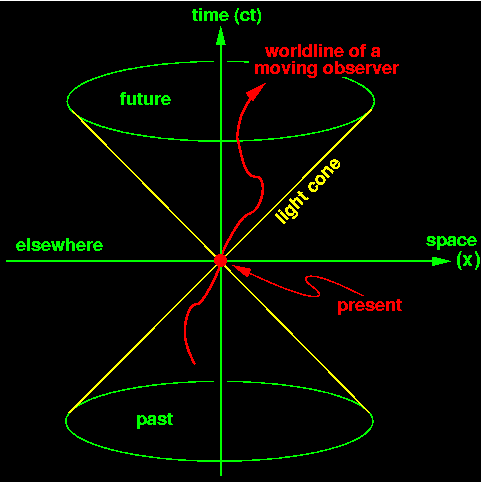
So we actually LIVE in this 4D space-time I was talking about.

When you are standing in one place, that means you are not moving forward in space, only in time. Thus you are moving along the time axis!

When you start moving in space, you still keep moving in time... so this is sort of what it looks like (again we are only looking at one direction in space):
So as you can see depicted, when you are standing still, your "space-time path" will be a straight line along the time axis, simply because you are not moving in space.

When you move, you will have traveled some distance in space, alas (as you can see on the picture), you will have moved over along the space axis as well as the time axis.

----

Now traditionally, one would think that the movement along the space axis is not connected to the movement along the time axis. But here's the magic: they are connected.

The truth is, when you decide to start moving in space, you are not adding an extra component to your velocity in space-time. No, instead, you are only rotating you velocity in space-time.

What????

That's right! In the Minkowskian space-time your velocity (or speed) vector is of a constant length. All you determine is which way you want to move with it! In other words if you move faster in the space direction, you will be moving slower in the time direction! Check it out on the graph below:


So now we have 3 different (purple) vectors depicted. You should imagine this as your speed. Now each of them is rotated at a different angle, thus each of them correspond to a different amount of movement in space. Notice how the one to the most right is moving the fastest through space, but the slowest through time. Compare this to any of the other ones, which are moving slower in space, but faster in time!

----

Ok, I know what you're thinking (or what you should be thinking): "Does this mean if I move fast enough in space, then I can stop time?!"
No. :( Sorry. That's because you have a limit of moving superfast in space, and that limit is none other than the speed of light!


Light moves pretty fast in space.. and you cannot move faster than it, sorry. The closer you "rotate" your space-time speed to Light's speed, the harder it will be to rotate it even more (in other words, to go even faster), and as a result, it is impossible to pass the speed of light.


I know this is getting to be a long post, but it's because I love this topic. I have to point out one more thing before I let you leave:

The faster you are moving in space, the slower you are moving in time. This actually explains the so-called "twin paradox", where you put one twin in a spaceship, send him off into space and wait for him to come back 50 years later. The twin who stayed on earth will now be 50 years older. The twin that was zooming around in a spaceship will be much much younger! His velocity in space was huge - so he was going very slowly in time, and he aged much slower than his brother.

An example we calculated in class: If the spaceship is travelling at 96% of the speed of light, and on Earth we wait for 50 years,  then the twin who was in the spaceship will have only felt 14 years passing, thus he will be 36 years younger than his brother who stayed on Earth.

Disclaimers: lots of what I told you here was not precise (for example it's actually your momentum that's constant in space-time, not your speed), and almost none of it was explained why it is that way... so it's really not a full lecture :)

Now please, try to imagine the world in such a way, that you are going very very quickly through time, and when you start moving around in space, you are just changing the direction of you speed. I think it's a cool feeling if you can imagine it properly. :) Have fun!


(Just another pic.: )

Thursday, February 6, 2014

The Beauty of Space-time - Minkowski space (Part1)

One of my favorites - Minkowski space-time. It is a very useful way of imaging the structure of space and time, especially when working with relativity theory.

Recipe:
Things you'll need:
-3 dimensions of space
-1 dimension of time
-a very unique inner product

Steps:
Take your three dimensions of space in the way you're used to it.
Now add your extra time dimension! Congratulations! You'r Minkowski space-time is almost finished! All you need to do is mix in your inner product and bake for a few million years.

Ok, what's this "inner product" I'm talking about?

---math start---

Ordinarily if you have two vectors, you can "multiply them", or create their scalar product. by multiplying their coordinates and adding those together:


For example, here you would get (1,5)*(4,2) = (1*4 + 5*2) = 4+10=14.
Yay!

Now just to simplify things, let's take the graph above, and let's call the 'x' axis our (traditional) space axis, and 'y' the time! So basically we're only going to be observing movement along one line.

Ok, so the inner product we will use will be the following: multiply and add the coordinates of the spacial parts of the vector as you usually do so, and subtract the multiplication of the time part of the vector from it!

It's really simple. So now, (1,5)*(4,2) = (1*4 - 5*2) = 4 - 10 = -6

(or generally: v*w = v_1 * w_1 + v_2 * w_2 + v_3 * w_3 - v_4 * w_4)

---math over---

What does this result in? Amazingly cool things! So the more interesting things will come in part 2! I decided to split this Minkowski topic in too, because I'm lazy right now, and this way next time I won't have to even mention math!