So we actually LIVE in this 4D space-time I was talking about.
When you are standing in one place, that means you are not moving forward in space, only in time. Thus you are moving along the time axis!
When you start moving in space, you still keep moving in time... so this is sort of what it looks like (again we are only looking at one direction in space):

When you move, you will have traveled some distance in space, alas (as you can see on the picture), you will have moved over along the space axis as well as the time axis.
----
Now traditionally, one would think that the movement along the space axis is not connected to the movement along the time axis. But here's the magic: they are connected.
The truth is, when you decide to start moving in space, you are not adding an extra component to your velocity in space-time. No, instead, you are only rotating you velocity in space-time.
What????
That's right! In the Minkowskian space-time your velocity (or speed) vector is of a constant length. All you determine is which way you want to move with it! In other words if you move faster in the space direction, you will be moving slower in the time direction! Check it out on the graph below:

So now we have 3 different (purple) vectors depicted. You should imagine this as your speed. Now each of them is rotated at a different angle, thus each of them correspond to a different amount of movement in space. Notice how the one to the most right is moving the fastest through space, but the slowest through time. Compare this to any of the other ones, which are moving slower in space, but faster in time!
----
Ok, I know what you're thinking (or what you should be thinking): "Does this mean if I move fast enough in space, then I can stop time?!"
No. :( Sorry. That's because you have a limit of moving superfast in space, and that limit is none other than the speed of light!

Light moves pretty fast in space.. and you cannot move faster than it, sorry. The closer you "rotate" your space-time speed to Light's speed, the harder it will be to rotate it even more (in other words, to go even faster), and as a result, it is impossible to pass the speed of light.
I know this is getting to be a long post, but it's because I love this topic. I have to point out one more thing before I let you leave:
The faster you are moving in space, the slower you are moving in time. This actually explains the so-called "twin paradox", where you put one twin in a spaceship, send him off into space and wait for him to come back 50 years later. The twin who stayed on earth will now be 50 years older. The twin that was zooming around in a spaceship will be much much younger! His velocity in space was huge - so he was going very slowly in time, and he aged much slower than his brother.
An example we calculated in class: If the spaceship is travelling at 96% of the speed of light, and on Earth we wait for 50 years, then the twin who was in the spaceship will have only felt 14 years passing, thus he will be 36 years younger than his brother who stayed on Earth.
Disclaimers: lots of what I told you here was not precise (for example it's actually your momentum that's constant in space-time, not your speed), and almost none of it was explained why it is that way... so it's really not a full lecture :)
Now please, try to imagine the world in such a way, that you are going very very quickly through time, and when you start moving around in space, you are just changing the direction of you speed. I think it's a cool feeling if you can imagine it properly. :) Have fun!
(Just another pic.: )
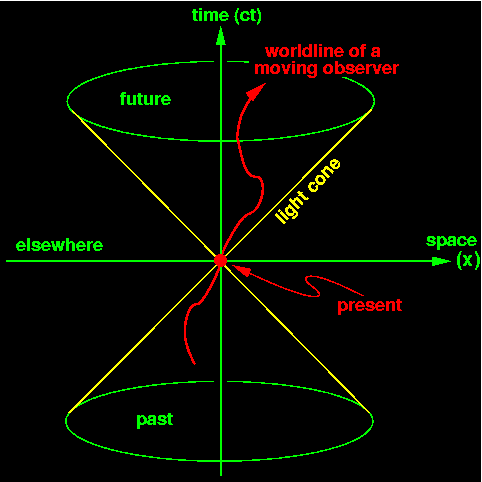

Nice article! But this famous example with the twins is wrong, because you can't use the special theory of relativity in this case. Why? The special theory of relativity assumes zero acceleration, so actually everything is just fine until that moment when the twin in the rocket decides to return to the Earth. At that moment he must turn his velocity vector v to -v and that is somethnig, that the STR can't do. I think, you can count this with the general relativity, but the diffrence in ages of those twins will be much smaller (a little over half a year).
ReplyDeleteThanks for pointing it out.
DeleteYes, it's true that this is not applicable to cases with acceleration. I should have used a more valid example. :)
Although I still think the difference would be larger than just a few months... but this is just a feeling; I should calculate it exactly one day.
Thanks for your contribution, Ana :)
You're welcome :)
ReplyDeleteWell, I have never tried to calculate the difference, because I haven't learned the general reltivity. I just remember this from my lectures of theoretical physics, I had last year.