Sunday, February 9, 2014

Knock knock... Who's there? Who is really there?

Have you ever wondered who you are?

Yes, you probably have... it's a quite common "teenager" question: Who am I?

But it's silly to think of it as a teenage question - knowing the answer to this question gives us great strength and allows us to live a stable and strong life regardless of our surroundings.

I'd like to share the point of view I've developed for defining myself - it is of course not at all an absolute truth or "The way to do it", but it is, I think, a very strong guideline, and it has helped me through many situations and gives a guide to my life.

So here's me: I am the decisions I make.


Of course years and years ago, at first, I was like: What I do is who I am. At a young age that seems to be at hand - When I do things, whatever I did was a result of me... so what I do is me. (what a lovely sentence :)

But of course getting into the teens, life becomes a bit more virtual - days and weeks go by, and you feel all that's changing are your thoughts. New thoughts, thoughts generating more thoughts, generating opinions and views. And it feels like I am my thoughts.

But then you get to meet new people and see new places and get to high-school (and do cool stuff, like start debating :), and all your previous opinions of the world fall apart and get rearranged and you get to see totally new ideas and perspectives... and it's pretty cool..

but it destroys the definition that you are your thoughts.

And the two theories shown above obviously aren't true. You can't be defined by your actions, because imagine this guy, Bill, in two parallel universes. In both universes Bill gets an email containing some information on a mafia leader, Bill gets up, goes over to that person and murders him. He is shot by some bodyguards right after the act.
Now in one universe he did it because he knew this was the only way he could prevent a genocide or something, in the other he did it because he knew this was a way he could get to unlimited power.
The two Bills did exactly the same thing, yet they were totally different people.

Of course a similar example could be brought for the other view that I am defined by my thoughts.


So I needed to get to the core of the problem, and after lots of thought I got to the simple conclusion, that I am defined by the decisions I make.

And it's comforting, because I am defined by my decisions... but I am the one who makes those decisions, so it's pretty cool, because I am able to define myself through the decision I make! :) It essentially leads right back to the whole Beckham thing - taking control of who I am.

And it's also very good in tough spots, because all you have to do is ask yourself, am I the person who does this/does that? It's a great perspective to steer yourself in the right direction. For example you're walking home from school and you see a blind person trying to cross the street. All you need to ask yourself is: "Am I a person who walks by pretending not to notice someone needs help or am I the person who recognizes the problem and sacrifices 2 minutes of his time?".

And it essentially comes down to basic morals - "Am I selfish and terribly lazy or am I selfless and caring?"

And before you know it it turns into: "Do I want to be selfish or do I want to be selfless?",
and you go from "Who am I?" to "Who do I really want to be?"

And in the beginning it's the small things, helping someone on the way home, being kind and understanding with a friend, studying a bit harder, sacrificing a bit of time and effort for others...

But it quickly grows and becomes much larger and more pressing!! Because if you've come to define yourself based on the morals of your decisions then you will have to rethink your life.

And soon I will continue with the sequel of the Deadly Train Switch.


Saturday, February 8, 2014

Minkowskian beauty - Part 2

Ok, here comes the interesting part!

So we actually LIVE in this 4D space-time I was talking about.

When you are standing in one place, that means you are not moving forward in space, only in time. Thus you are moving along the time axis!

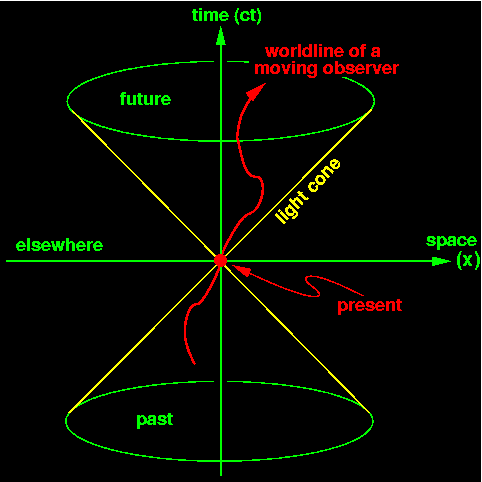
When you start moving in space, you still keep moving in time... so this is sort of what it looks like (again we are only looking at one direction in space):
So as you can see depicted, when you are standing still, your "space-time path" will be a straight line along the time axis, simply because you are not moving in space.

When you move, you will have traveled some distance in space, alas (as you can see on the picture), you will have moved over along the space axis as well as the time axis.

----

Now traditionally, one would think that the movement along the space axis is not connected to the movement along the time axis. But here's the magic: they are connected.

The truth is, when you decide to start moving in space, you are not adding an extra component to your velocity in space-time. No, instead, you are only rotating you velocity in space-time.

What????

That's right! In the Minkowskian space-time your velocity (or speed) vector is of a constant length. All you determine is which way you want to move with it! In other words if you move faster in the space direction, you will be moving slower in the time direction! Check it out on the graph below:


So now we have 3 different (purple) vectors depicted. You should imagine this as your speed. Now each of them is rotated at a different angle, thus each of them correspond to a different amount of movement in space. Notice how the one to the most right is moving the fastest through space, but the slowest through time. Compare this to any of the other ones, which are moving slower in space, but faster in time!

----

Ok, I know what you're thinking (or what you should be thinking): "Does this mean if I move fast enough in space, then I can stop time?!"
No. :( Sorry. That's because you have a limit of moving superfast in space, and that limit is none other than the speed of light!


Light moves pretty fast in space.. and you cannot move faster than it, sorry. The closer you "rotate" your space-time speed to Light's speed, the harder it will be to rotate it even more (in other words, to go even faster), and as a result, it is impossible to pass the speed of light.


I know this is getting to be a long post, but it's because I love this topic. I have to point out one more thing before I let you leave:

The faster you are moving in space, the slower you are moving in time. This actually explains the so-called "twin paradox", where you put one twin in a spaceship, send him off into space and wait for him to come back 50 years later. The twin who stayed on earth will now be 50 years older. The twin that was zooming around in a spaceship will be much much younger! His velocity in space was huge - so he was going very slowly in time, and he aged much slower than his brother.

An example we calculated in class: If the spaceship is travelling at 96% of the speed of light, and on Earth we wait for 50 years,  then the twin who was in the spaceship will have only felt 14 years passing, thus he will be 36 years younger than his brother who stayed on Earth.

Disclaimers: lots of what I told you here was not precise (for example it's actually your momentum that's constant in space-time, not your speed), and almost none of it was explained why it is that way... so it's really not a full lecture :)

Now please, try to imagine the world in such a way, that you are going very very quickly through time, and when you start moving around in space, you are just changing the direction of you speed. I think it's a cool feeling if you can imagine it properly. :) Have fun!


(Just another pic.: )

Thursday, February 6, 2014

The Beauty of Space-time - Minkowski space (Part1)

One of my favorites - Minkowski space-time. It is a very useful way of imaging the structure of space and time, especially when working with relativity theory.

Recipe:
Things you'll need:
-3 dimensions of space
-1 dimension of time
-a very unique inner product

Steps:
Take your three dimensions of space in the way you're used to it.
Now add your extra time dimension! Congratulations! You'r Minkowski space-time is almost finished! All you need to do is mix in your inner product and bake for a few million years.

Ok, what's this "inner product" I'm talking about?

---math start---

Ordinarily if you have two vectors, you can "multiply them", or create their scalar product. by multiplying their coordinates and adding those together:


For example, here you would get (1,5)*(4,2) = (1*4 + 5*2) = 4+10=14.
Yay!

Now just to simplify things, let's take the graph above, and let's call the 'x' axis our (traditional) space axis, and 'y' the time! So basically we're only going to be observing movement along one line.

Ok, so the inner product we will use will be the following: multiply and add the coordinates of the spacial parts of the vector as you usually do so, and subtract the multiplication of the time part of the vector from it!

It's really simple. So now, (1,5)*(4,2) = (1*4 - 5*2) = 4 - 10 = -6

(or generally: v*w = v_1 * w_1 + v_2 * w_2 + v_3 * w_3 - v_4 * w_4)

---math over---

What does this result in? Amazingly cool things! So the more interesting things will come in part 2! I decided to split this Minkowski topic in too, because I'm lazy right now, and this way next time I won't have to even mention math!